

At 8:00 a.m., your competitor stole that call.
At 8:07 a.m. on Wednesday, Lin had just parked his van in front of the building materials market on Guangling 4th Road in Hongkou District when his cell phone rang.
It's an old client, Auntie Zhang. But the caller wasn't looking for him. “Master Lin ah, I was going to call you, but my son-in-law searched for ’plumbing repair Hongkou’ on his cell phone, and the first thing that popped up was that ”Fast Repair to Home', and the call went through. People have already sent someone on their way ......"
Lin Jianguo gripped his cell phone, knuckles white. He knows about “Fast Repair to Home“ - a chain of platforms that entered Shanghai only last year, with stores in Pudong and advertisements all over the city. His quotes are 40% more expensive than his own, and his response time is not necessarily faster. But when customers search, it is in the first place.
This is not the first time. Mr. Lee, who repaired the toilet last month, and Ms. Chen, who unclogged the drain three months ago, were lost this way. It's not that the craftsmanship is inferior, it's that the phone simply didn't ring.

This is not Lin's predicament alone. Open up Google and search for any local service - “air conditioning repair,” “orthodontics,” “pet baths ” - you see exactly the same picture: the top three to four positions are firmly occupied by chain brands, aggregation platforms, and national merchants. They may not know the street better than you do, but they certainly know how to buy locations better than you do.
Google's local search has a brutal math: there are only three ad spaces on the first screen. Mobile is even tougher, sometimes two fills the screen. The user's finger doesn't have to swipe, the decision is already made. Research shows thatThe top three results split 75%+ clicksAnd the first alone can take nearly a third of the traffic. It's not a technological confrontation, it's a battle for attention. If you show up a second late, the customer has already pressed someone else's call button.
More anxiety-inducing is the time difference. Lin's people are used to dispatching orders in the morning, catching up at noon, and reconciling accounts in the evening. But Google Ads bidding starts in the wee hours of the morning. When your competitors adjust their bidding strategies at 2:00 a.m. on Wednesday, you may be asleep. When you wake up, the day's share has already been divided.
But it's not a dead end.
There's a crack in the local search battlefield in 2026 that most people overlook: the big players are buying big terms like “plumber“ to cover the whole city or even the whole province. They're looking for scale, not precision. AndLocalized battlegrounds are precisely the opportunity for small businesses--If you know how to pin ads to specific coordinates like “plumber in Guangzhong Road, Hongkou District“, if you can make your ads appear just right when customers search for “drain cleaning 24 hours near me“ - then the budgetary advantages of chain platforms will become an albatross for them instead. If you know how to nail an ad to specific coordinates like "Hongkou District, Guangzhong Road, plumber", if you can make it appear just when a customer searches for "sewer 24 hours near", if you can make the landing page show up with a cell phone number and a WhatsApp button in the first second - the budgetary advantage of the chain becomes their burden.
This article is going to talk about one such set of plays.It's not about you dropping big bucks to compete, it's about you making every dollar spent fall in that radius of true door-to-door service. From keyword selection to geo-targeting, from negative word lists to landing page design, we'll turn that phone call that Lin's missed into an order you'll pick up tomorrow.
Because the real dividing line in this battle is not who has more money, but who knows more - what the customer actually knocked down in the search box before they made that call.
An Overlooked $10 Billion Market Is Exploding
Lin Jianguo sat in the car for a full ten minutes after he hung up the phone. He opened his cell phone and once again searched for the word that made his heart beat faster: “Drainage Hongkou District”. On the screen, the advertisement of “Quick Repair to Home” was still like a nail at the top. When he clicked on the ad, the page for the chain's platform popped up, and the huge “Book Now” button flashed brightly. He looked up from his van, which had a phone number printed on it, and suddenly realized a much bigger question: what kind of amazing speed and amount of money are calls like Auntie Zhang's flowing into the hands of these players who know how to play the numbers game this morning, all over the country, all over the world?
It's not a zero-sum game where you're dead or alive. It's a huge gold mine that's still exploding, and you're living right on top of the vein.
The research data reveals a counterintuitive reality: the global local services market has reached a massive $652.9 billion by 2024. But that's just the prelude. More aggressive forecasts indicate that the market is undergoing a dramatic “digital blowout,” reaching $315.1 billion by 2026 - followed by a CAGR of 14% all the way up to 1,020 billion dollars by 2035 at a CAGR of 14%.
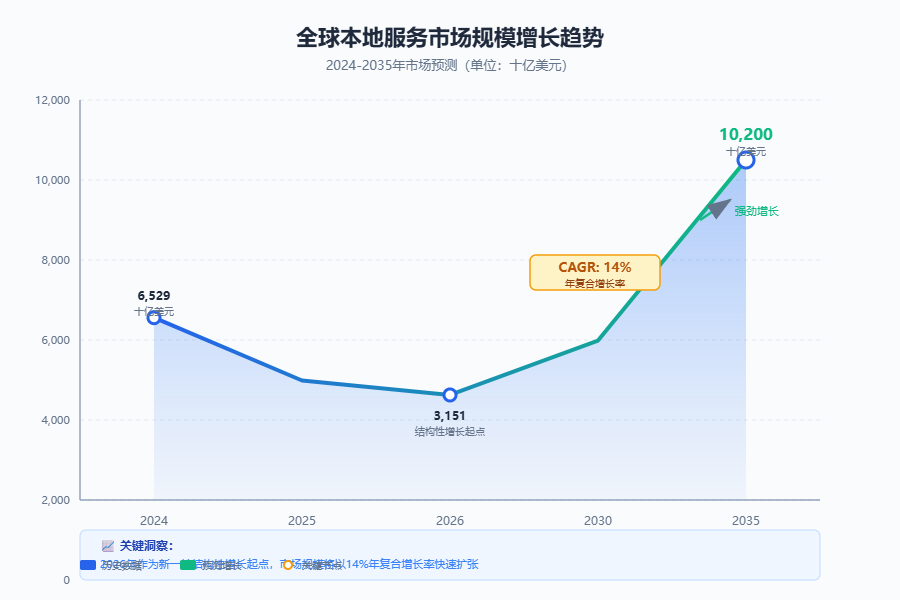
What does this number mean? It is not a cake added out of thin air. It is the irreversible migration of the consumption behavior of countless individuals like Lin Jianguo and Auntie Zhang's son-in-law. In the second year since the smartphone became a “body organ,” the behavioral path for users to find services has become radically shorter and straighter. In the past, if you wanted to repair a water pipe, you might look for small advertisements in the hallway or ask your neighbors, and the whole process was “ask and see”. Now, you take out your cell phone, type in “through the drain master Hongkou 24 hours”, the moment your finger touches the search button, the intention has been locked - I want to find, can immediately come to the door of the person, right here.
The nature of user behavior has changed from “information exploration” to “action execution”.
Google, the gateway to over 90% searches worldwide, is the ultimate trigger for this decision-making action. It is not an electronic window for people to wander around, but a paid window where customers have already taken out their wallets and are ready to order. When Lin Jianguo anxious “why customers do not find me”, he did not know that these customers have already left a clear “purchase intent” in the search engine. Who appeared in the right place at the moment of search, who will be able to receive a paid phone call.
And the size of transactions in this window is zooming by at an unprecedented rate. Imagine a trillion-dollar market by 2035, and where will its traffic and transaction touchpoints be primarily done? The answer is hidden in your phone's search box.
This outburst is not a rainy day. Instead of diluting budgets, it has brought about a high concentration of traffic. When the willingness to pay of the whole market has been quickly educated and user habits have been solidified, the competition will quickly focus on a few key “digital entrances”. Local service ads, especially search ads represented by Google Ads, is the new battleground in this new battlefield.The most critical landing pointIt connects the customer's “immediate need” with your “service capability”. It connects the customer's "immediate needs" with your "service capabilities", with no room for anything in between.
A plumber, a dentist, a pet groomer ...... These traditional “street businesses” are today standing in front of a once-in-a-century structural opportunity. This market is no longer regional and slow-growing. It is undergoing digital restructuring, for those who can accurately target customers within the “three kilometer radius” of the service provider, providing a lever to pry tens of billions of market.
The numbers don't lie. Trends are indisputable. The question is no longer “do I want to do it”, but “how do I catch the wave of dividends coming my way”. When clients are ready to pay, the next step is to make sure you're the one they find.
Keywords chosen correctly, come are prospective customers
At 5:30 a.m., in an old public house on Ouyang Road in Shanghai's Hongkou District, sixty-three-year-old Auntie Zhang was awakened by the sound of water pipes in the bathroom. She tiptoed over to the bathroom and found that water had begun to pool on the floor. Her partner has mobility problems, and ten years ago, she would have had to knock on her neighbor's door and look up the not-so-reliable master's number in her phone's address book. But now, she did the natural thing - pulled out her cell phone, tapped the search box, and typed in six words: “Drain Master Hongkou”.
Three minutes later, the first call came in.
This is not a fictionalized image. This is what happens every morning in every major city and neighborhood in China. And the first question you, as a local service provider, need to answer is: what makes your ad appear in front of Auntie Chang's eyes the moment she presses the search button?
The answer is hidden in those six words - “through the drain master Hongkou”. If you choose the right keywords, all the prospective customers will come with their needs. Keywords chosen wrong, show to those who are just curious about “how much money through the drain” “through the drain tutorial” of the visitors, money burned, people did not.
There is only one keyword strategy for local services at its core: service + location, and you can't have one without the other.
If a strong guttering master only puts in the word “guttering service”, he is sending his advertisement to everyone in Shanghai and China who is curious about this word. But change it to “Drainage Master Shanghai Hongkou District”, the situation is different immediately - every person who sees this advertisement has a clear intention: I need to find a master, now, immediately, in Hongkou District. This means that his search needs and your service capabilities coincide in both geographic and category dimensions.
And that's not all. On top of “service + location,” there's another category of words that can directly kick conversions up a notch - local intent words. “Nearby”, “home”, “24 hours”, “how much”, “contact number” - these words seem unassuming. Contact number“ - these words may seem insignificant, but they are the kick in the pants of the user's decision-making chain. The person who searches for ”Master Hongkou“ may just want to know the market, but the person who searches for ”Master Hongkou" 24 hours door-to-door, the plumbing is likely to have been missed, and he cares about not comparing, but who can be the fastest to get to the door.
So your keyword library, can not only dry category words, have to be like a jigsaw puzzle to the local intent word superimposed on: “through the drain Hongkou how much” “pipe dredging Jing'an District on the door” “plumbing repair Shanghai 24 hours! ”. Each combination of words filters a layer of irrelevant traffic until all that's left are prospective customers running to call.
But it's not enough to know what words to add, you have to know what to exclude.
Every local service provider's advertising budget is being eaten up by the “silent enemy” - those who search for “free plumbing,” “plumbing tutorials,” “plumbing part-time,” “plumber jobs,” "plumber jobs," "plumber jobs," "plumber jobs," "plumber jobs," and "plumber jobs. ", "free plumbing", "plumbing tutorials", "plumbing part time", "plumber wanted". They're not looking for you to do work, they're looking to take advantage, to learn, and to get a job and submit a resume. If you don't cut them out of your display, your click-through price will be jacked up by all this invalid traffic at the same time that real customers are instead kept out because their budgets are burned out early.
Negative keywords are the firewall, and Google Ads search ads allow you to set up “blacklists” to exclude specific terms. In the list of negative keywords for local services, there are a few words that are always a must: free, tutorials, do-it-yourself, recruitment, job search, school, homework, how to, and how much (if you're only placing branded terms, you can leave this one out). Spend fifteen minutes once a month checking your negative keyword list, and you'll find yourself wasting up to thirty percent less advertising dollars.
Finally, a word about the usage of the three keyword matching methods.
Precise matching is the main force. Only put “pipeline dredging Hongkou District” such words, the search intent is highly compatible, click on the people in ten in seven or eight is really to find the master. The good thing is that the conversion rate is high, less waste, the bad thing is that the traffic ceiling is low if you only put the precise match, it is likely that every day so dozen show.
Phrase matching is your flexible wing. If you set “unclogging” as a phrase match, users“ searches that include this word may show up, such as ”Shanghai unclogging company“ and ”how much does unclogging cost". That's a lot of scope, but with it comes a mishmash of intent - you'll have to filter out irrelevant searches further with negative keywords.
Adding signals to broad matches is something you should only do in the mid to late stages of the game, and Google now allows you to add “custom signals” to broad matches, such as setting the “Area” to Hongkou District in Shanghai, and “Industry” to the type of service you specialize in. “set to the type of service you specialize in. This is the equivalent of adding a manual calibration to broad match, but it still shows ads to semantically ”likely relevant" searches. Be careful about using this tactic without enough account data and a budget - or you'll soon realize that your money has been poorly spent.
These four actions - picking the right precise long-tail terms, overlaying local intent terms, setting up a negative keyword firewall, and picking the right matches - add up to your first weapon in the local battle that is Google Ads. With the right keywords, behind every click that comes is a person with a need. In the next chapter we'll talk about how keywords aren't enough, you have to get your ads in the right geographic areas.
Don't let advertising dollars be wasted 30 kilometers away
The keywords have been chosen correctly, but Auntie Chang's phone still hasn't reached you.
She searched for “drain cleaner Hongkou 24hrs“ and your ad did appear - the problem was that it appeared for a potential customer in another district. That customer lives in Pudong, saw the ad, thought the price was right, and called for three minutes to ask if you could come over, and all you could say was, “It's too far away. In those three minutes, your click price has been deducted.
This is the most insidious waste of geotargeting: it's not that you're not advertising, you're advertising to the wrong people.
Google Ads“ default geographic settings are rarely touched by local service providers. The system usually selects “interested in the area“ for you, which is a trap. People who are ”interested“ include those who are planning to move, those who are traveling to make tips, and even those who are just searching for “Hongkou house price“ to see what's going on. They're not in your service radius, but their clicks keep coming. The only option you should really choose is two Chinese characters: ”live“. Change the setting to “live in the area" to ensure that the people who see the ads are actually living in Hongkou and can use your service.
⚠️ take note ofGoogle Ads defaults to “interested in the area,“ which automatically pushes your ads to people who are traveling, researching a move, or even just curious about home prices - they'll never become your customers. Be sure to manually switch to “live in the area“ and regularly check the actual location of your users in the search term report to prevent the system from “getting smart“ and expanding your reach.
But it's not enough to pick a “residence“.
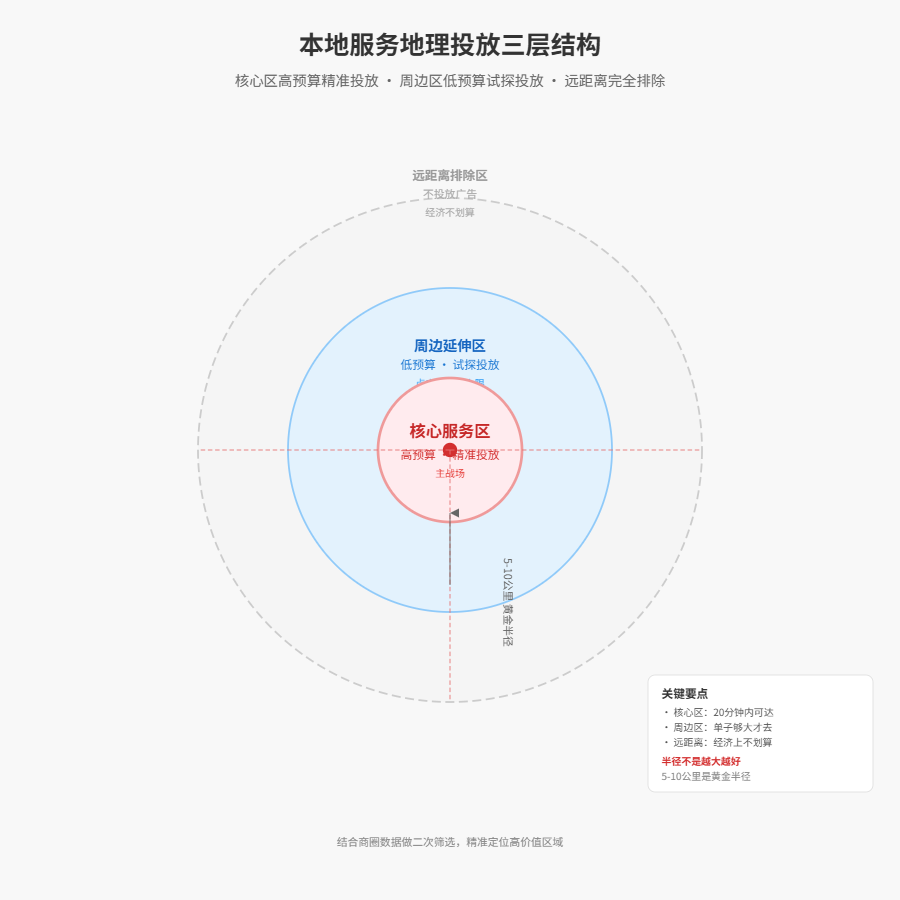
Every local service provider should have a map in their mind. Not a map of neighborhoods, but an overlay of “where I can go“ and “where I'd like to go“. The core area is the street, neighborhood, business district where you are based, the place where an electric car can come to your door in 20 minutes. This is your main battlefield, the budget should be tilted here, click price can afford to be higher, because the conversion rate is guaranteed. Expanded outward a circle is the surrounding area, you can go but not willing to make a special trip, unless the single big enough. Here the budget should be lowered and the click price capped for traffic supplementation. Further out is the no-go zone - it's not physically impossible to get to, it's economically uneconomical. Instead of spending forty minutes traveling across the city stuck in an elevated traffic jam, give the list to your local counterparts where your ads shouldn't even be appearing.
The mistake many people make when drawing this circle is greed. Thinking that the larger the radius, the more opportunities, pull the placement range to thirty kilometers, fifty kilometers, covering the whole city. The data looks beautiful, the display volume goes up, but the truth is: in the decision-making chain of local services, distance is an invisible sieve. When a customer looks for a gutter master, a locksmith, or a manicurist, he is subconsciously calculating how long it will take to get there. Your advertisement appears thirty kilometers away, the people who click on it are not high intention users, they will hesitate when they see the distance, and if they hesitate, they won't be converted, and the price of your click is all wasted.
The empirical data is clear: 5 to 10 kilometers is the golden radius for most local services. Any smaller and the traffic pool is too shallow; any larger and the conversion rate falls off a cliff. This isn't a pat on the head, it's a lesson learned from countless accounts burned.
But radius is just the starting point, not the whole story. Truly savvy geo-targeting does secondary screening in conjunction with business district data. In your area, which places live your target customers? High-end neighborhoods are concentrated in areas with high demand for property maintenance and high customer unit prices; corporate parks and office buildings are densely populated, with steady demand for business printing, greenery leasing, and janitorial services; and old neighborhoods are clustered together, with appliance repairs and plumbing three times as often as newer cities.Google Ads allows you to refine your placement area down to specific business districts, zip codes, and even custom polygonal maps. Spend half an hour to study your city's population heat map, average price distribution of neighborhoods, office density, your advertising will be able to change from “casting a net“ to “hitting the target“.
To give a specific example: the same is the pipeline dredging service, put in Hongkou District, you can choose to cover the entire administrative district, you can also only vote along North Sichuan Road to Lu Xun Park this core area. The former show a large amount but mixed, the latter show a small amount but accurate - search “pipeline dredging“ of the probability of people living in those buildings in the old house, leakage is a real emergency, the phone over the turnover rate is very high. Save the budget to invest in this core area, your click price is higher than the competitors, it does not matter, because you have not wasted a penny in remote areas.
There is another category of targeting that is easily overlooked: exclusions. Do you have a list of “unserved areas“ in your account? There are some areas you've actually been to, but the experience was horrible - too far to travel, difficult to park, empty return trips, and the list is a pain in the ass. Then remove it from geo-targeting. Some customer types you also do not want to take, such as certain high-end neighborhood properties have a fixed partner, you go is also in vain. Set these areas as excluded and your advertising dollars won't be wasted in places destined for no results.
Geo-targeting and keywords are a combination. Keywords determine “what to say“ and geo-targeting determines “to whom to say“. When Auntie Zhang searched for “Master of Tong Drainage Hongkou“, your ad appeared in front of her eyes because of the precise geo-targeting, and the phone call came to you because the keyword match hit the right spot in her mind. Without any of these, she would have slipped to that chain of platforms, that competitor who is 30 kilometers away but is willing to burn ads.
After you set this up, don't wait to pop the champagne. Next week, open the search term report and you'll see where users are actually searching and where they're clicking. Are there areas appearing that you've clearly excluded? Are there core areas where click prices are perversely low? The data will tell you if that circle you drew is really in the right place.
Geo-targeting is the finest sieve of local advertising. Sift right, and every dollar is spent on people who can turn into customers. Sift it wrong, and your ad budget is doing market education for your competitors - letting users know what the approximate price point is for this type of service, and then they cross out your number and call the person who actually appears in the top three search results.
The place that burns the most advertising dollars happens to be the biggest pitfalls
Your ad account is like a big kettle with several holes cut in the bottom. The keywords are accurate, the geo-targeting is right, but the water is still leaking fast. Because these holes are opened exactly where you are most willing to pour water.
The first hole is in the keywords. Many people feel that “the more people searching for my services, the better,” so their keyword lists are filled with big words like “plumber,” “cleaning,” “dental,” and so on. “ and so the keyword list is full of big words like ”plumber,“ ”cleaning,“ ”dental," and so on. These words search volume is huge, it looks like the traffic is surging, but you look closely at the search in the end what people think - "plumber license how to test" "cleaning wages generally how much" "dental hospital hours" - all to inquire about the market, to understand the industry, and even looking for work. They don't have an immediate need to buy, but your click-through price is going to be deducted just the same.
The real world picture is like this: you voted for “plumber”, a high school student doing school social research searched for “plumber's prospects” and saw your ad, and clicked on it out of curiosity; you voted for “dental assistant”, a recent college graduate searched for “dental assistant jobs” and swiped your ad to see how it paid. You voted for “Dental” and a recent college graduate searched for “Dental Assistant Recruitment” and swiped your ad, wanting to see how it would be treated. Every time you click, you are paying for someone else's “curiosity” and "inquiring". The real customer, the kitchen sink is overflowing aunty Zhang, searched for "drain master Hongkou District 24 hours", she may be because your budget was wasted by those in front of you, and did not make the top three, the phone call to your downstairs that only cast the precise words of the master.
The second hole is the absence of “filters”, i.e., negative keywords, Google's algorithm is very clever, but its task is to help you “expand” the traffic, not to “clean” the traffic. The Google algorithm is smart, but its task is to help you “expand” traffic, not “clean” traffic. You voted for “nail art”, it may show your ads to people searching for “nail art training”, “nail art apprenticeship”, “nail art pictures”. “. Without a clear list of negative keywords telling it ”no to these", it will generously spend your money to cover searches that are semantically "sort of similar" but intend to be "not at all close" to each other. searches that are semantically "somewhat similar" but "completely unrelated" in intent.
The hole is invisible because the report shows “clicks” and it's hard to tell at a glance if the searcher behind those clicks is actually looking for a manicure. It's not until you take stock a month later and realize that you've had few inquiries, but your budget is bottoming out that you realize what's going on. A basic list of negative keywords should include at least “free”, “classes”, “tutorials”, “jobs”, “salary”, “salary” and “salary”. “salary” “DIY” “how to” "how to" "school " "homework". These are a few words that will block at least 30% invalid clicks. That's not being conservative, it's making every dollar you spend count.
The third hole is in the geo-directional setting. In the previous chapter we talked about selecting “live in the area”, but this is not enough. The bigger waste comes from the “too big heart” of the targeting scope. You are a beauty salon serving Jing'an District, but you have added “Shanghai” as the targeting area in your account. You think that covering the whole city is an opportunity, but the reality is that customers living in Minhang District, even if they want to try your services, will be dissuaded by the distance of “30 kilometers”. The fact that your ads appear in front of them is a mismatch of resources.
Even worse, this sloppy “province-wide” or “city-wide” targeting puts your ads in direct competition with the big chain brands across the city and province. Their budgets are so deep that they will pay a premium for every “potential” click. You a small community store, with a limited budget to go with them to grab these “heart dishonest” remote traffic, is like using a rifle to fight against artillery coverage, losing without suspense. Your money is burned on raising prices for customers you can't even serve.
The fourth hole, and one of the easiest to overlook, is the one that makes all the difference: the landing page. You spend a lot of money, with accurate keywords and geo-targeting, a real customer in urgent need of services to your “store door”. As a result, you show him your company's magnificent homepage, brand history and corporate culture. He is looking for a phone number that can be dialed immediately, or a WeChat button that can be used for direct conversation, but he got lost on your home page, turned around for ten seconds without finding it, and then pressed the back button in annoyance, and clicked on the next search result - the one that puts the phone number in the center of the web page with a large font size of the competitor.
For local services, the average window of time for a customer to go from search to decision is incredibly short, maybe just a few minutes. Your landing page has only one task: to lead him to contact you with the shortest path possible. This means that the phone number must be visible at first glance on the screen and clicked to call; the green button for WeChat or WhatsApp must be visible enough; and in the case of a form, there must be no more than three fields (name, phone number, address/problem description). Any content not related to “Contact Now” - such as team photos, certificates of honor, lengthy service descriptions - should be put in the back, or simply deleted.
A real life example of what happens when you patch all those holes.
There is a community dental clinic in Changning District, Shanghai, the owner of Dr. Chen initially put Google Ads made almost all the above mistakes. He put in big words like “dental implants” and “orthodontics”; he didn't have any negative keywords; he geotargeted the entire city of Shanghai; and the landing page was linked to a complex “department introduction” subpage on the clinic's official website. The landing page was linked to a complex "department introduction" sub-page on the clinic's website.
The result? Burning through $8,000 a month in advertising for only 5 valid phone inquiries, with a conversion cost of $1,600. He almost gave up, thinking online advertising was a scam.
Later, a friend who knows what he's doing helped him make adjustments:
- Keywords changed to “dental implants Shanghai Changning District” “orthodontics near which good” and added “how much money” “pain” and so on. The keywords were changed to "dental implants Shanghai Changning District" and "orthodontics nearby which is good" with "how much" and "does it hurt".
- The list of negative keywords adds “free”, “booking platform”, “training” and “hospital recruitment”.
- Geo-targeting is accurate to Changning District and 2-3 neighboring streets, read “live in the area”.
- A stand-alone landing page was created with a huge “24 Hour Consultation Number” banner at the top, a simple appointment form in the center, and three doctor profiles and screenshots of patient testimonials at the bottom.
After just two weeks, the numbers changed. Advertising costs dropped to $5,000 per month, but valid phone inquiries rose to 25. Conversion costs plummeted from $1,600 to $200, a drop of nearly 60%. Dr. Chen noticed that the quality of the calls coming in was extremely high, and almost all of them were prospective clients who lived in the neighborhood, had clear problems, and had appointments to come in the house the same day or the next day.
Dr. Chen's story is not a miracle, he just plugged the holes that leaked money. Your advertising dollars are not being spent too little, but are leaking too much. The places that seem to get the most traffic and are the “safest” placements are often the places where your budget evaporates the fastest. Precision isn't about limiting, it's about protecting - protecting every dollar you spend from going only to the people who really need you and can find you.
Plug all those holes, and all that's left in your chamber is a bullet that hits the bull's-eye.
The true story of a small neighborhood store that won over a chain store
After plugging those holes where money leaks out, the next thing to look at is how people in the real world are actually making money with these methods.
Lao Zhang has been doing pipe unblocking in Hongkou District for fifteen years, and his neighbors know that he is good at his craft and quick to respond. But since the neighborhood opened two national chain of housekeeping platform, his phone began to become less. Those platforms have a lot of advertisements, Lao Zhang will not play online promotion, can only rely on the introduction of old customers and downstairs to send business cards.
The twist happened when he asked his son to help him make a Google Ads account. My son did not throw keywords, only chose the words “pipeline dredging Hongkou District” “Hongkou District Drainage Master” “toilet repair Hongkou”, all of them are The precise combination of “service + specific area”. The scope of delivery is also controlled in Hongkou District plus a few neighboring streets, never run far away.
In the first month, Lao Zhang spent only 1,800 yuan on advertising in exchange for 47 valid phone inquiries. The second month the number rose to 62, of which more than half of the same day on the door. The most surprising thing is that some customers on the phone directly said “in the Baidu search for you, said the Hongkou side of the fastest through the drain master”. That month, his monthly customer acquisition has been the same as the two chains, and advertising expenditure is only one-third of theirs.
Lao Zhang's method of winning is simple: he doesn't try to be seen by people all over the city, he just lets the guy in Hongkou District, who is fretting about a clogged toilet, see him at first glance the moment he turns on his cell phone.
There is a five-year old dental clinic on Wujiang Road in Jing'an District, with a small area and only three doctors. Dental implants are their high-end program, single charge of 10,000 to 20,000, but before the online promotion has never been able to do. I have invested several times in the word “dental implants”, “dental clinic”, click a few dollars, look at the data is okay, but very few callers to consult.
Later they changed their set of playing style. The keywords were all coupled with regional and intentional words: “dental implants shanghai jingan district” “dental clinic jingan district” “how much dental implants jingan district”“ Orthodontics neighborhood which is good”. The geo-targeting only selects Jing'an District plus two neighboring districts, checking “live in the area” rather than “interested in the area”. What's more, they made a separate landing page for dental implants, with three doctors“ dental implant case comparisons at the top, a huge ”Book a Dental Implant Consultation Now" button in the middle, and three rows of patient testimonials and credentials at the bottom.
This combination hit and the conversion rate did 8%. what does that mean? What does that mean? Eight out of a hundred people who visit the landing page call or submit an appointment form. For a service like dental implants, which has a high unit price and high decision-making difficulty, this number is already quite significant. What's more, the quality of the traffic is extremely high - it's full of customers in and around Jing'an district who have a clear need for dental implants and are willing to pay for quality. The clinic's monthly revenue on this program has risen directly to 210,000 from the original 120,000 to 130,000 dollars.
The third story takes place in front of a residential neighborhood in Pudong. The owner, Xiao Chen, opened a pet store, washing, cutting and blow-drying, boarding and pet supplies. Online promotion was too complicated for her, she didn't even know what “landing page” meant, she just knew how to send circles.
Her son helped her put a few words into Google Ads: “pet bath near me,” “pet store Pudong,” “pet boarding near me,” all in the “service + neighborhood” model - she knew all too well that all the people who came to her shop were residents of the surrounding neighborhoods, and that no one would travel halfway across Shanghai to give her dog a bath. All "service + nearby" model - she knows too well, come to her store are residents of the surrounding neighborhoods, no one will go halfway across Shanghai to give her dog a bath. The radius of delivery is only set at five kilometers, covering four or five residential districts in the vicinity.
The second week after the advertisement was launched, Xiaochen made a decision: to hang the QR code of WhatsApp on the advertisement, so that customers could add her and send messages directly once they clicked on it. Her idea is very simple: many young people do not like to make phone calls, but send a message to ask “can you give Teddy a bath” threshold is much lower. The result was surprisingly good. Consultation volume than before increased by 60%, many are nine o'clock in the evening ten o'clock to send a message to ask “, tomorrow the earliest time can be sent over”. Chen almost every second back, she is in the store, photo video now shooting now send, customers feel especially down to earth. That month, her monthly income rose from eighteen thousand to thirty-six thousand, a whole doubled.
These three stories are in different industries and at different scales, but they are highly consistent in what they do right: precise keywords to ensure that people coming in really want the service; precise geo-targeting to ensure that people coming in are really in the serviceable range; extremely fast response to ensure that people coming in don't get lost in the wait; and localized landing pages to ensure that people coming in find you at first glance.
None of these maneuvers are difficult on their own, but together, they are the nuclear weapons of the small merchant against the big chains. Your precision will leave the broad budgets of big business with nowhere to spend; your regional focus will make you the only option on your own turf.
And the next step is the way it's time to put them together.
Ten-minute optimization checklist for tomorrow's results
Old Zhang's son spent two nights running through his Google Ads account without spending a dime on an agent or buying any fancy tools. Two weeks later, Lao Zhang's advertising efficiency had doubled, and the phone was ringing much more intensively than usual.
You don't need to be an expert to get your hands dirty. Each of these five steps can be done in less than ten minutes. Do them tonight and you may see a difference tomorrow.
Step 1: Check keywords, with or without geographic names and service characteristic words
Open your Google Ads account and go to the “Keywords“ tab. Go through the existing words one by one.
When you see a word like “plumbing“, stop. Ask yourself: Is the person searching for this word looking for a master in Hongkou District, or checking industry news? If it's the former, change it to “pipe unclogging Hongkou District“ or “Hongkou District Drainage Master“. See “dental implants“, change to “dental implants Shanghai Jing'an District“ or “Jing'an District dental implants how much money“.
Geographic names can't be saved. people still pitching big words in 2026 are essentially working for Google - spending their own money, training its algorithms, and then watching visitors who click but never call waste your budget.
Service characterization words should also be added. Words like “urgent,” “24-hour,” “door-to-door,” and “price” are filtering for people who are ready to spend money on The people who are ready to spend money. A person searching for “toilet clogging how to do“, and searching for “toilet clogging Hongkou District 24 hours door to door“, the conversion rate may be ten times different.
Change it tonight. You don't have to change it all, just pick the five most trafficked words and do it first.
Step 2: Set up negative keywords, first exclude “free“ “tutorials” “recruitment” three words
Negative keywords are shields, not icing on the cake, they are life savers. Your ad could be showing up right now to people searching for “free training for plumbers“, “drain tutorial videos”, “plumber wanted” - these people click on it, you pay for it, and then it disappears. -These people click, you pay, and then disappear.
Go to “Negative Keyword List“ in “Share Library“ and create a new list.
Add these three first:Free, Tutorials, Recruitment。
Then expand: courses, school, homework, DIY, do-it-yourself, paycheck, job search, resume, college, pdf, download.
If you only serve Shanghai, add “Beijing Plumbing“ and “Guangzhou Drainage” to the list.Google won't save you money, it will only spend it for you. It is your own business to block invalid traffic.
Do this step right and your bills will be lighter and your valid calls will become more frequent next month.
Step 3: Adjust geo-targeting to “live in the region“ to exclude unserved places
Click on the “Geolocation“ setting and you may now see a whole city or even the “whole province“. This is wrong.
Cut the range to the areas you can really serve. If you're in Hongkou district, pitch Hongkou district, if you're in Jing'an district, pitch Jing'an district. If your business covers multiple districts, build separate ad groups, pitch one district per group, and bring the name of the district with you in your dialog.
Here is the key setting: change “locate“ from “people interested in the location“ to **“people who live in or are regularly located in the area ”**.
This is a switch that many people don't notice. By default, a foreigner who is planning a trip to Shanghai and searches for “Shanghai Dental Clinic“ will see your ads. He clicks, you pay, and he never becomes your customer.
The exclude function should also be used. If you're explicitly not going to certain areas, like Pudong masters not going to Puxi, add Puxi to the exclusion list. Every penny should be spent on places you can ride to get to.
Step 4: Optimize the landing page by replacing the home page with an exclusive page for local services, with phone and WhatsApp at the top
This step requires jumping out of Google Ads and back to your website.
Where are you directing traffic now? If it's the home page of the company's website with a large brand description, team photos, and service category navigation - the customer is looking for a phone number, you're letting him stroll through the museum.
Make a specialized service page. First screen at the top: large headline with district and keywords (“Hongkou District 24 hours plumbing unclogging”), one line below that talking about the core selling point (“fifteen years of experience, thirty minutes to the door, do not pass no charge”), and then the huge phone number and the WhatsApp button. No need to scroll to see it.
Only down the line are cases, qualifications, and customer reviews. But these are the icing on the cake, and the phone number on the top line is the silver lining.
Why did Xiao Chen's pet store double its conversion rate? Because her son put the WhatsApp link directly on the advertisement, and customers jumped out of the chat window when they clicked on it. Young people don't like to make phone calls, but they are willing to send a “can I give Teddy a bath tomorrow“. Your page should cater to both.
If you can't change your website on your own, spend a couple hundred bucks on an outsourcer and make a single page. It's worth a lot more money than the advertising dollars wasted on ineffective traffic.
💡 tipDon't let your customers “treasure hunt“ on the landing page - put the phone and WhatsApp buttons on the first screen where they can be seen at first glance, in a font size big enough for your finger to click on, and in a color that pops out of the background of the page. People who can't find contact information in three seconds will close the page in the fourth and go to your competitors.
Step 5: Set up conversion tracking and make sure you can count phone calls and WhatsApp messages
The first four steps were getting the right people to come, this step is confirming that they actually acted.
Google Ads only tracks “clicks“ by default, but you want “calls“ and “messages“. Clicks don't equal business, conversions do.
Go to “Tools and Settings“ in the “conversion“, create a new conversion operation. Select the type of “phone“, fill in the phone number on the site, Google will give you a code, or if your site with a common site building tools (WordPress, Wix, Shopify), you can directly use the plug-in interface.
WhatsApp tracking is slightly more complicated, but it can be done. Add a UTM parameter to the WhatsApp link, or set up an intermediate jump page so that the customer clicks and goes through a stats page before jumping to the WhatsApp conversation.
Without tracking, you are driving in the dark. I don't know which word brings a phone call, I don't know which region's customers only see not to play, I don't know how to optimize. Set up a good tracking, a month later to look back at the data, you will clearly see: the original “Hongkou District emergency through the drain“ this word, ten clicks can be exchanged for three phone calls; and “pipeline repair“ this word, thirty clicks are no one cares.
Now you can decide: add money to vote for the former and suspend the latter.
It doesn't necessarily take one night to do all five steps. KEYWORD checking and negative keywords, maybe twenty minutes. Geo-targeting adjustments, five minutes. Landing page if it already has a foundation, change copy and button placement, half an hour. Conversion tracking setup, may take an hour to research the first time, but once and for all.
Lao Zhang's son started the change on Wednesday night, and on Friday morning, Lao Zhang received calls from two new clients, both of whom said they had “Googled Hongkou District Tongqu“. That's speed.
You don't need to wait for all the conditions to be right. Open your account now and start with the first step. Change a word, add a negative word, shrink a small geographic area - every little move is picking up wasted money.
That client tomorrow who is desperate for a service, the first thing they see when they search, could be you.
Big business has a budget, but you have key junctions
On the corner of that street, the truck from the home improvement chain always arrived five minutes before Old Zhang's electric car. The image grated in his mind for a whole month.
There are thousands of bigger plumbing companies in the country with budgets that could buy the word “plumbing”. You can't afford it, and you don't have to. The battle is never won or lost on a map of the country, it's five kilometers around your house, on a route you can take with your eyes closed. The moment a customer searches on their cell phone, they don't want a brand, they want someone who will show up at the door and solve the problem.
That's where you come in.
The advertising department of a large corporation may be responsible for three cities, the budget is evenly distributed, and the keywords are set by the marketing department. In your Google Ads account, on the other hand, the keywords are the ones that your neighbors actually knock down in the search bar every day: “Who's coming to Hongkou District with a clogged toilet?”, “Can you install an air conditioner in Jing'an District today?”. You're geographically oriented to the same street neighborhood committee precincts that you serve every day. You put all your money and energy into that point, like nailing a plank with an awl - enough pressure and the plank goes through.
Precise keyword and geo-targeting isn't just a trick, it's your nuclear weapon. When national chains spread their money to travel planners and curious students in a “province-wide” setting, every cent of your advertising dollars reaches the neighbor who just turned on the tap and found no water. It's not a competition for budget, it's a war for efficiency. Your shells are smaller, but the charge is purer and you hit more accurately.
Old Zhang figured this out on a Thursday afternoon. On the fifth day after his son changed the advertisement, he received a phone call, and the person on the other end asked, “You're that Master Zhang in Hongkou District who can be there in thirty minutes, right? I saw you on Google, my house has a bad water leak.” At that moment Lao Zhang knew that the van around the corner that always arrives first may not always win.
Start optimizing now, and tomorrow the client's call could be yours. You don't have to wait for next Monday's meeting, you don't have to wait for your budget to be approved, and you don't even have to wait to read this article. All you have to do is open Google Ads and do one thing: flip the “live in the area” switch from the default “interested”. It only takes three seconds, but it will act as a gate to keep out traffic that doesn't belong to you and isn't working.
It's never too late to take action, the key is to start. The chain's marketing plan moves forward on a quarterly basis; your optimization can be measured by the minute. While they're discussing ROI statements, you've already gotten your third client call of the day.
The real battlefield of local services is not in TV commercials or national conferences. It is in the one-inch square search results on the cell phone screen, in the combination of the words “service + location + urgency”. You hold this key intersection, you hold the business of the whole street.
The neighbor who's desperate for service is turning on his phone. Are you optimized?
🔑 criticalDon't let perfectionism be your excuse today - take a minute now to flip the “live in the area” locator switch. The chain's annual marketing program may still be in the boardroom waiting for approval when you get that phone call tomorrow from that exact search term. Speed of action is the only weapon you have to exceed your budget.
